
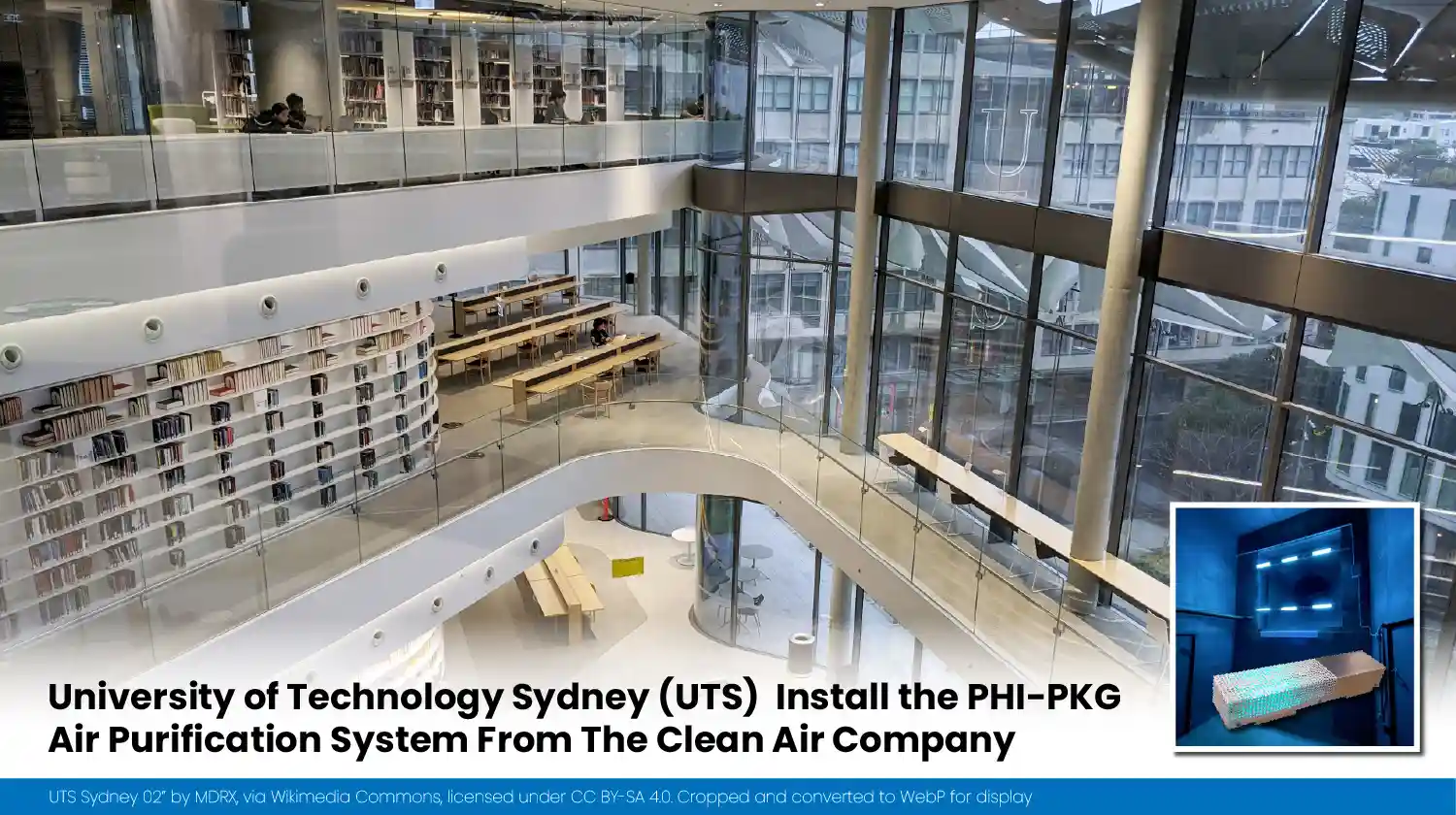
Australia’s commercial ventilation framework is evolving. AS 1668.2:2024 has renewed attention on how mechanical ventilation systems are designed, calculated and documented to support healthy indoor air quality.
This does not mean every existing commercial building must immediately increase its air-change rate. Application depends on the building, the work being undertaken and the National Construction Code provisions adopted in the relevant state or territory.
For new developments, fit-outs, refurbishments and changes of use, however, achieving an indoor air quality outcome through outside air alone can be costly. It may require larger plant, additional ductwork, revised controls and greater heating, cooling or dehumidification capacity.
Before committing to those changes, project teams should consider whether PHI active air purification could form part of a project-specific equivalent clean-air strategy.
By maintaining the outside air needed for occupancy and carbon dioxide control, while using active treatment to help manage microbial contaminants, mould, odours, selected volatile organic compounds and airborne particles, some projects may be able to avoid HVAC alterations that are larger, more disruptive or more expensive than necessary.
What Has Changed Under AS 1668.2:2024?
AS 1668.2:2024 replaced the 2012 edition of the Australian Standard covering mechanical ventilation in buildings. Standards Australia’s overview highlights updated contaminant-management provisions, revised airflow calculations and clearer quantified requirements.
The requirements vary according to the space type, occupancy, contaminant sources and compliance pathway. Australian Standards also do not automatically become law when they are published. The National Construction Code is given legal effect through state and territory regulatory frameworks, with adoption dates and local requirements determined by the relevant jurisdiction.
The practical takeaway is not that every existing building must introduce more air. It is that ventilation and indoor contaminant control increasingly need to be properly assessed, supported by evidence and clearly documented.
Why More Outside Air Can Mean More Cost
Outside air remains essential. It dilutes internally generated pollutants and helps manage occupant-generated CO₂. However, before outdoor air enters a conditioned space, it may need to be filtered, heated, cooled or dehumidified.
Increasing outside-air capacity can therefore create several knock-on requirements:
- Larger air-handling or cooling equipment
- New or enlarged ductwork and intake louvres
- Additional fan and electrical capacity
- Upgraded controls and building-management systems
- More demanding humidity management
- Higher ongoing heating and cooling energy use
These challenges are particularly significant in existing offices, schools, hotels, restaurants, gyms and aged care facilities, where plant rooms may be constrained and mechanical works can interrupt daily operations.
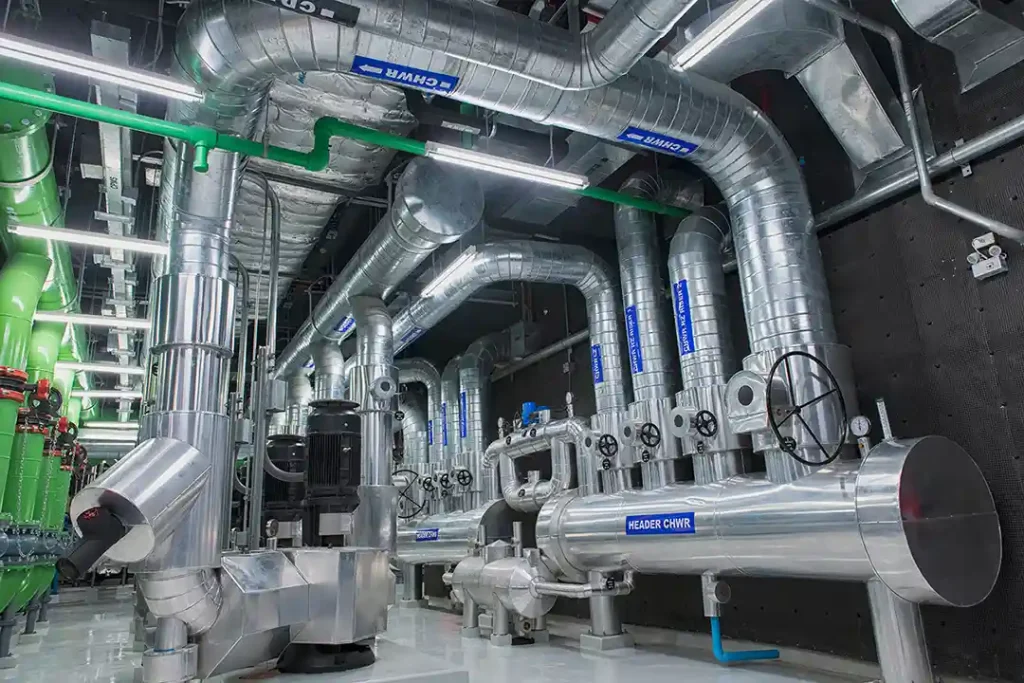
Increasing outside-air capacity can place additional demands on existing HVAC plant, controls, ductwork and building services.
A smarter strategy asks how much outside air is genuinely required and whether validated controls can address part of the remaining contaminant load more efficiently.
Appendix D and an Equivalent Clean-Air Approach
The engineering method outlined in Appendix D allows a project team to consider several clean-air contributions when assessing selected contaminants:
- Minimum outside-air ventilation
- Filtration of recirculated air
- Validated air-cleaning equipment, including PHI
- Natural deposition or decay relevant to the selected contaminant
The combined contribution may then be assessed against the prescribed outcome for microbial contaminants, VOCs or odours.
Recognition of PHI within this pathway is project-specific. Room volume, occupancy, airflow, existing filtration, equipment performance and commissioning information should be documented and considered by the project’s suitably qualified professionals.
Project Support from The Clean Air Company
The Clean Air Company can help package the product and project information needed to explore an equivalent clean-air approach.
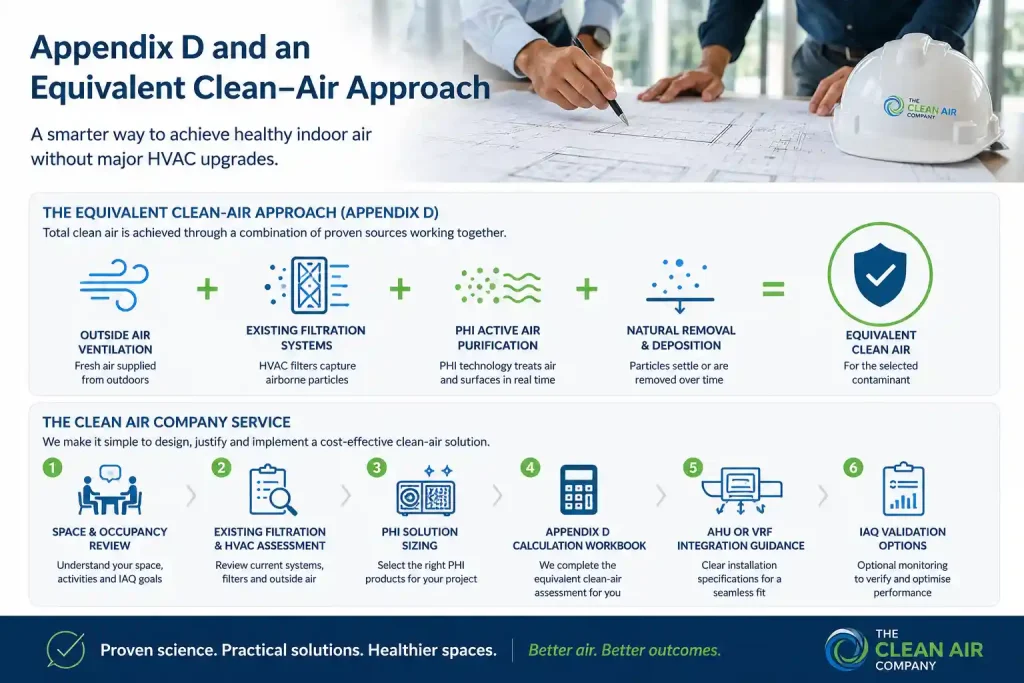
A project-specific Appendix D assessment can combine outside air, existing filtration, PHI clean-air delivery and natural removal for the selected contaminant.
What Is PHI Active Air Purification?
PHI stands for Photohydroionization®. It is an active air-treatment process designed to help reduce selected contaminants in the air and on surfaces throughout a treated space.
The technology uses UV light and a hydrated catalytic cell to create low-level airborne hydrogen peroxide within the airstream. These active molecules are carried into the occupied environment, where they can help reduce bacteria, viruses, mould, odours and selected VOCs.
This differs fundamentally from passive filtration. A conventional filter waits for contaminated air to travel through the room, reach a return-air path and pass through the filter media. PHI carries treatment into the occupied space, allowing it to work closer to where contaminants are introduced.
Explore the Clean Air Company’s commercial active air purification solutions.
Why Active Purification Goes Beyond Conventional Filtration
Mechanical filtration can continue to perform a useful particle-capture role within an HVAC system. However, it has practical limitations when relied upon as the primary response to mould, microbial contaminants, odours or VOCs.
A filter treats only the air that physically reaches it. It does not directly treat exposed surfaces, and its performance depends on suitable airflow, correct selection, effective sealing and regular maintenance.
Filters also capture contaminants rather than actively treating them. Used media can accumulate dust, mould spores and other pollutants, creating recurring labour, handling and disposal requirements. Loaded filters should be removed carefully to reduce the possibility of disturbing accumulated material. The US Centers for Disease Control and Prevention recommends appropriate containment procedures during HVAC filter replacement.
PHI adds proactive treatment throughout the airstream and occupied environment, while existing filters can continue performing their particle-capture function.
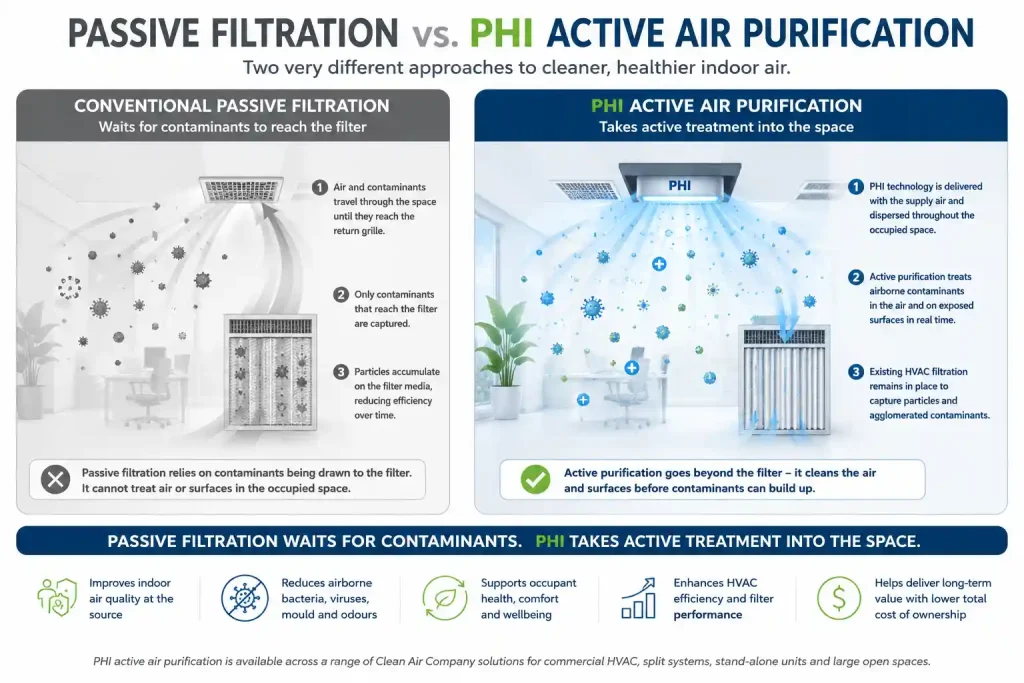
Passive filtration treats air after it reaches a filter, while PHI distributes active treatment through the airstream and occupied environment.
Where PHI Can Deliver Commercial Value
Mould and Microbial Contaminants
Mould normally indicates moisture ingress, condensation or humidity problems. The source must be corrected and affected materials may require remediation.
Although PHI cannot resolve the source of moisture ingress, it can support the response by helping reduce airborne mould spores and other microbial contaminants after source control has been addressed.
Airborne Virus Concerns
In classrooms, offices, reception areas and care environments, contaminants are continually introduced by occupants. Passive filtration begins acting once contaminated air reaches the unit, whereas PHI adds treatment within the occupied space itself.
Safe Work Australia’s current guidance recognises good air quality, including ventilation and air cleaning, as an important control for managing biological hazards in workplaces.
Odours and VOCs
Persistent odours can undermine customer confidence and make an otherwise well-maintained building feel unclean. Increasing outside air is a conventional response, but it can add a considerable load to the HVAC system.
PHI is designed to help reduce selected odours and VOCs rather than simply masking them.
Airborne Particles and Allergens
Selected Clean Air Company systems combine active purification with ionisation technology to support particle reduction. By charging fine particles, the technology can encourage them to cluster together, allowing larger agglomerated particles to settle more readily or become easier for existing HVAC filters to capture.
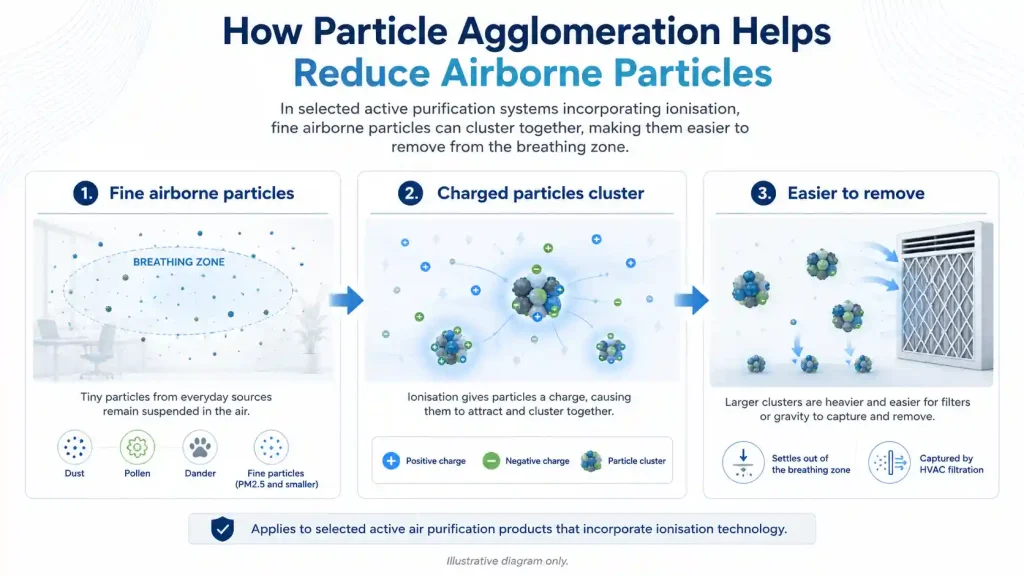
Selected active air purification systems incorporating ionisation can charge fine particles, encouraging them to cluster and become easier to remove.
Real Australian Commercial Applications
PHI technology is already being used across Australian education, hospitality, local-government and commercial environments. These genuine Clean Air Company projects demonstrate how active purification can be adapted to different buildings and air-quality challenges.
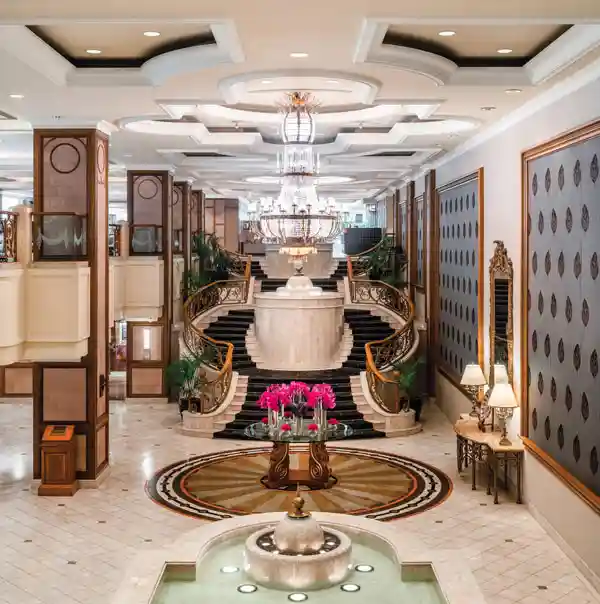
Mould and microbial contaminants
The Langham Melbourne
PHI active air purification was deployed across guest rooms, public areas, restaurants, bars and key back-of-house spaces.
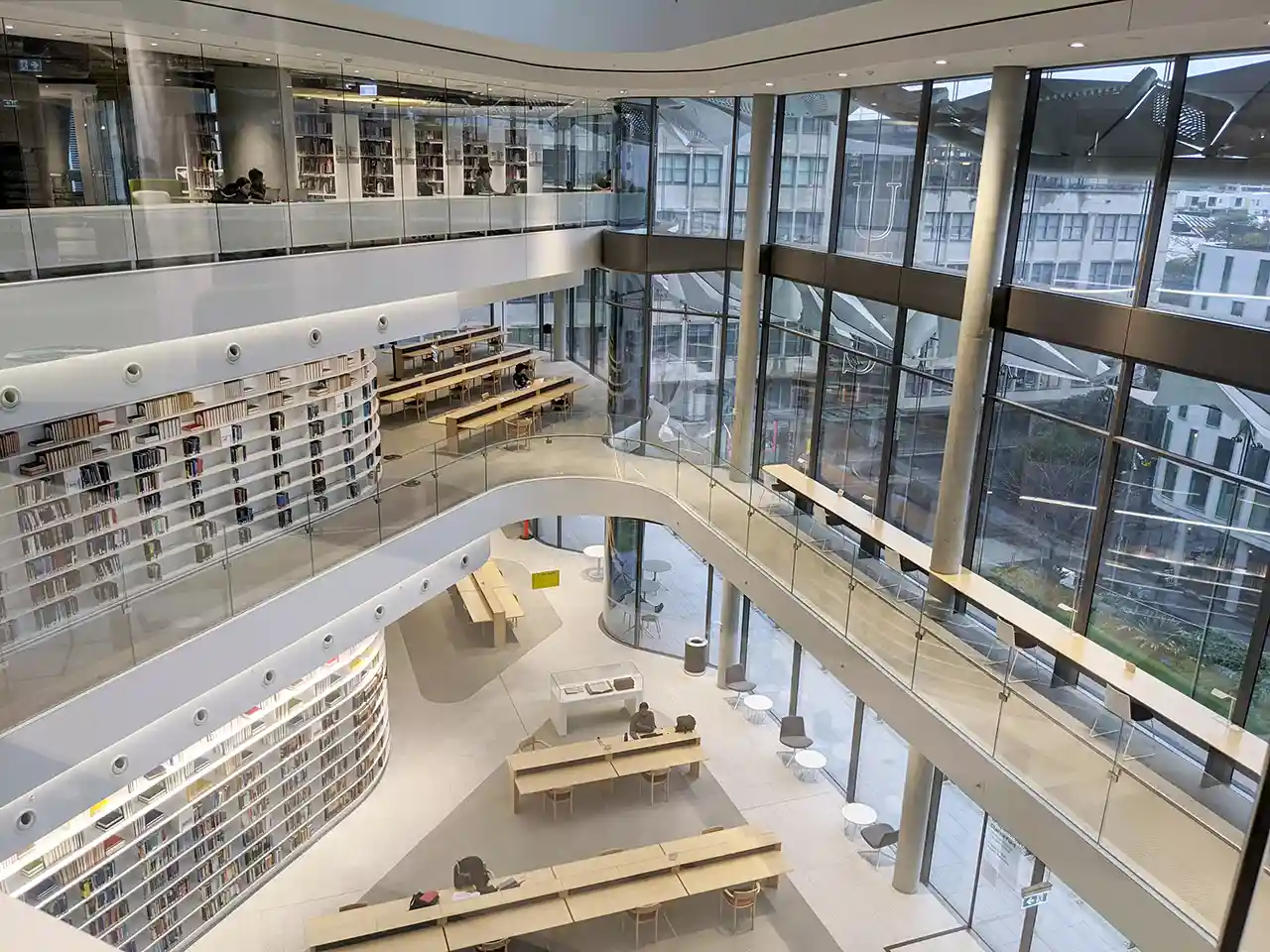
Commercial-scale HVAC integration
University of Technology Sydney
UTS installed 28 PHI-PKG units within two high-capacity air-handling systems in Building 1.
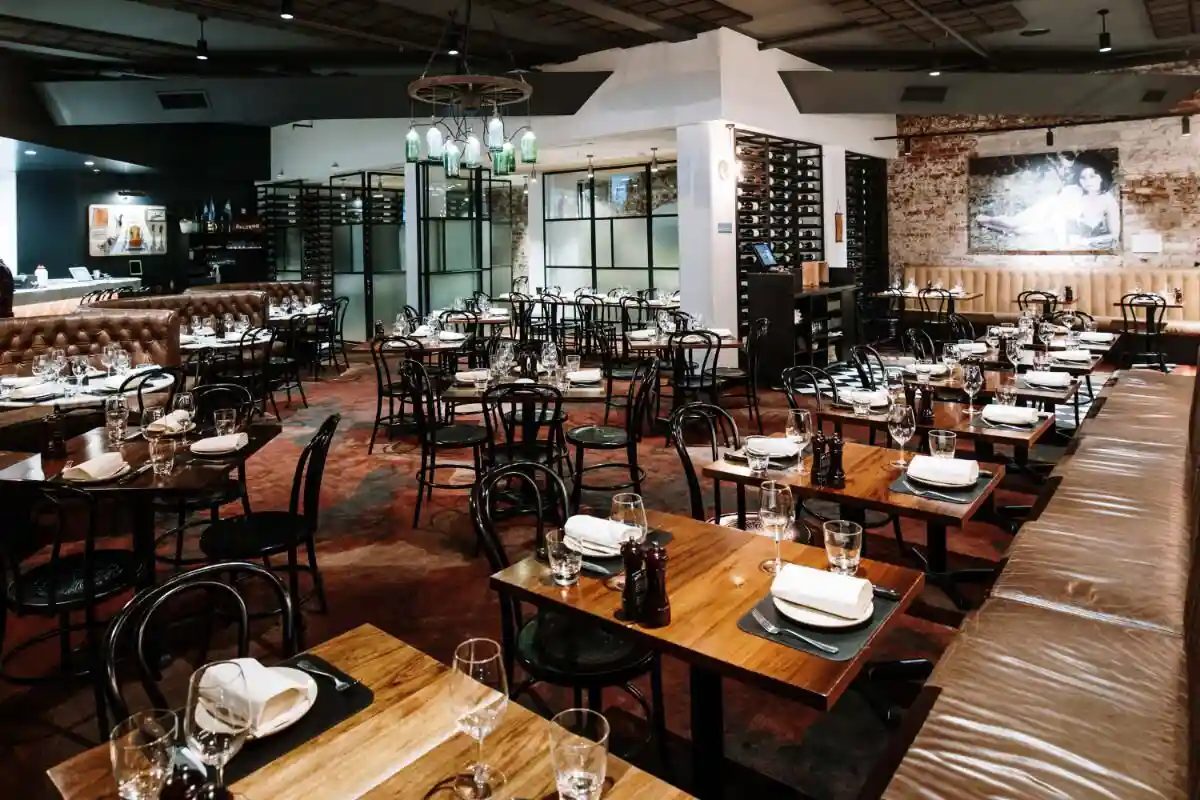
Odour control
Palermo Restaurant, Melbourne
A standalone HALO-ROVE unit was used to address persistent bathroom odours within the subterranean venue.
Workplace air quality
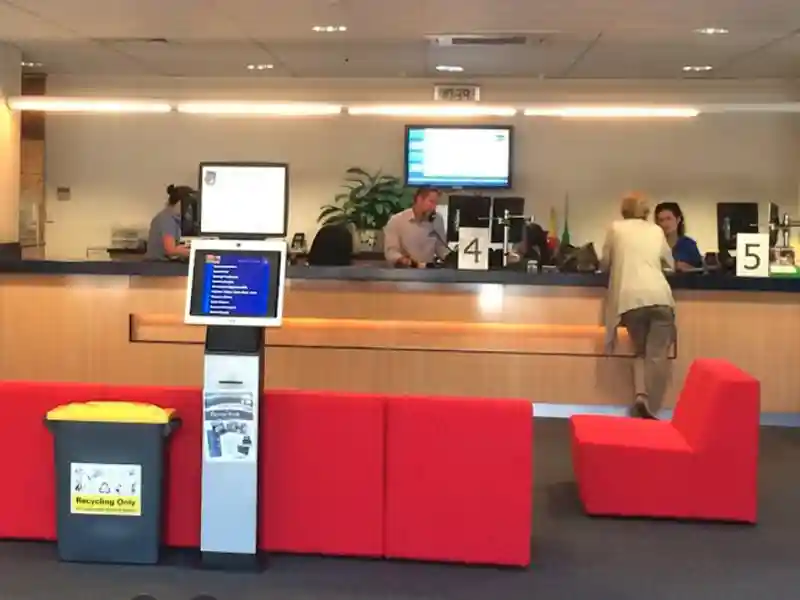
Coffs Harbour City Council
Active air purification was introduced across council office and depot environments to support healthier spaces for staff and visitors.
PHI and CO₂
PHI does not eliminate the need for ventilation. Occupant-generated CO₂ should continue to be managed through an appropriate minimum supply of outside air or a demand-controlled ventilation strategy.
PHI’s value lies in helping address other contaminant categories, allowing the ventilation system to focus on the functions that genuinely require outside air.
PHI Solutions for Different Commercial Environments
The Clean Air Company supplies active air purification options for a wide range of existing and new commercial HVAC arrangements:
- PHI-PKG™ for larger central HVAC and commercial air-handling applications.
- PHI-MSP™ for many split-system and fan-coil applications.
- HALO-ROVE™ for standalone treatment where HVAC integration is not practical.
- Airius PureAir PHI® for active purification and air circulation in large or open internal environments.
The Clean Air Company is the official Australian Master Distributor for RGF air purification products, providing local access, product knowledge and technical support.
The service extends beyond equipment supply. The team can help project stakeholders review the contaminants of concern, assess the HVAC arrangement, size an appropriate solution, provide typical AHU or VRF integration information, prepare an initial Appendix D workbook and discuss IAQ validation options.
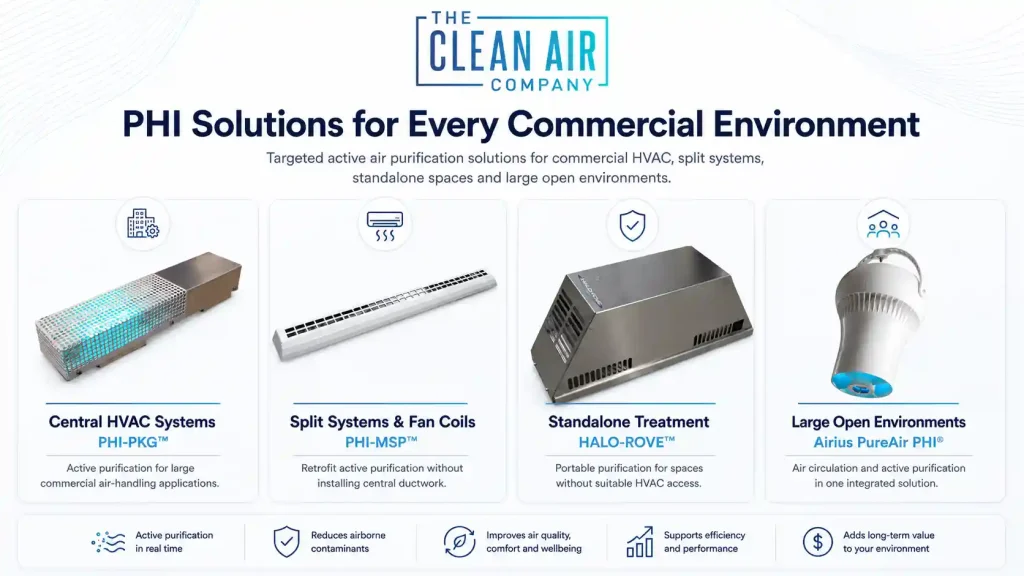
The Clean Air Company offers active air purification solutions for central HVAC, split systems, standalone applications and large open environments.
Indoor Air Quality and WHS Responsibilities
Safe Work Australia states that persons conducting a business or undertaking must provide and maintain a work environment without risks to health and safety and manage risks associated with ventilation and airborne contaminants.
Australian Standards are not standalone laws in every circumstance. However, they may become relevant through the NCC, project specifications, contractual obligations, approval processes and evidence of whether reasonably practicable controls were considered.
A properly assessed and documented indoor air strategy therefore supports occupant wellbeing, better project decision-making and stronger compliance management.
Better Indoor Air Without Unnecessary HVAC Expansion
AS 1668.2:2024 reinforces the importance of properly calculated, evidence-based ventilation and contaminant control. For some Australian developments, fit-outs and refurbishments, responding through outside-air increases alone could mean larger plant, more ductwork, higher energy consumption and considerable disruption.
That does not need to be the first option considered.
PHI active air purification gives project teams a more targeted way to address microbial contaminants, mould, odours, selected VOCs and, in appropriate systems, airborne particles.
Where its clean-air contribution can be demonstrated through a project-specific engineering assessment, PHI may also reduce pressure to meet the full contaminant-control requirement through conditioned outside air. Minimum ventilation and CO₂ control remain important, but expensive mechanical expansion may not need to carry the entire indoor air quality burden.
With solutions for central HVAC, split systems, standalone applications and large spaces—supported by calculation tools, integration guidance and IAQ validation options—The Clean Air Company can help turn active purification into a practical project strategy.
Frequently Asked Questions
Can PHI support a reduction in outside-air requirements?
Potentially, for selected contaminant categories such as microbial contaminants, VOCs or odours. Any adjustment should be supported by project-specific calculations, appropriate product-performance data and the relevant engineering and approval process.
Can PHI be retrofitted into an existing commercial building?
In many cases, yes. The Clean Air Company offers solutions for central HVAC systems, fan coils, split systems, standalone treatment and large open environments. The appropriate option depends on airflow, room volume, occupancy and the contaminants being addressed.
Does PHI help with airborne dust and allergens?
Selected active purification products incorporate ionisation technology that charges fine particles and encourages them to agglomerate. This can help larger particle clusters settle more readily or become easier for existing filters to capture.
Can PHI help reduce disruption during a commercial retrofit?
Where a project-specific assessment supports an equivalent clean-air approach, PHI may reduce the amount of additional plant, ductwork or structural alteration needed to address selected contaminants.
What support can The Clean Air Company provide?
Support can include space and occupancy review, PHI sizing, an initial Appendix D calculation workbook, typical AHU or VRF integration details, technical product information and IAQ validation options for discussion with the project’s mechanical engineer or certifier.
Does PHI replace the need to control moisture or remediate mould?
PHI can support mould-management measures by helping reduce airborne spores and microbial contaminants. The underlying cause of moisture ingress, condensation or excessive humidity should still be identified and corrected.
Does PHI remove carbon dioxide?
No. Occupant-generated CO₂ should continue to be managed through suitable outside-air ventilation or demand-controlled ventilation. PHI complements these measures by helping address other contaminant categories.

Early project assessment can help determine whether PHI active air purification may reduce the need for extensive HVAC alterations.
Speak to The Clean Air Company Before Upsizing Your HVAC System
Planning a commercial development, fit-out, refurbishment or ventilation review?
Before committing to larger plant, new ductwork or disruptive building alterations, discuss whether PHI active air purification could provide a more focused and cost-effective solution for your building.
References and Further Reading
- Standards Australia: Spotlight on AS 1668.2:2024
- Australian Building Codes Board: About the National Construction Code
- Safe Work Australia: Duties of a PCBU
- Safe Work Australia: Managing the Risks of Biological Hazards in the Workplace
- Australian Government: Indoor Air Quality
- CDC: Environmental Infection Control and HVAC Filter Replacement